
Every custom antler chandelier starts with the room. From ceiling height, proportions, natural light, to furniture scale, each defines the piece before a single antler is selected. Species, configuration, and light count follow from there.
This guide covers the decisions that shape a commission: how antler species differ in structure and scale, how ceiling height and room dimensions define what fits, how the construction process works, and how to plan light output before the build begins.
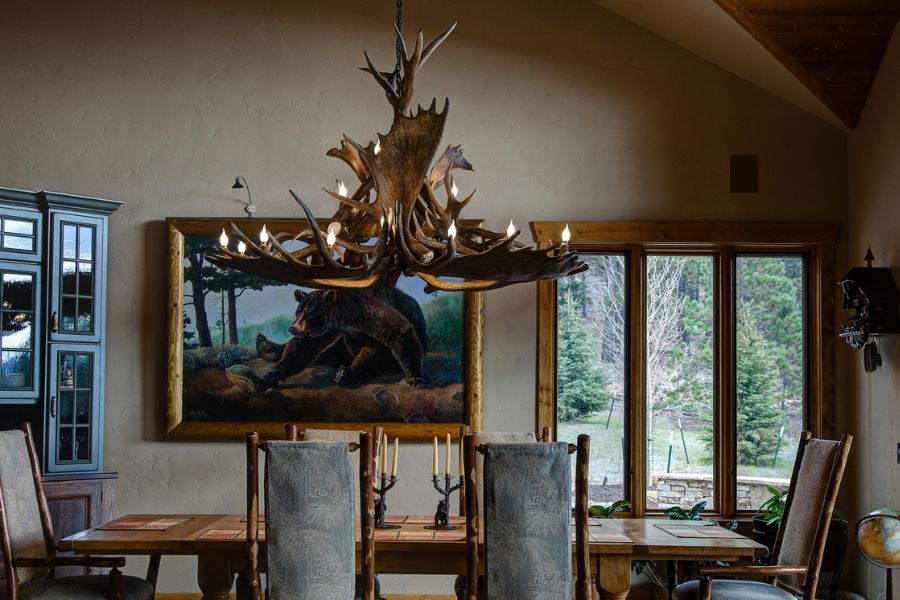
How Species and Antler Type Shape a Custom Chandelier
The species of antler defines the character and visual weight of a chandelier. Elk, mule deer, whitetail, moose, and fallow deer each produce antlers with different sizes, branching structures, and densities. Knowing what each species looks like and how it behaves structurally is the first step in specifying a piece.
Elk antlers produce the largest antlers of the North American deer species used in chandelier design. The main beams are long and sweeping, curving back from the skull before reaching upward, with multiple tines branching off the top half of the beam. A mature bull elk rack can span four feet or more. That length and the pronounced curve of the beams give elk antler its structural reach, making it the primary material for large-format and multi-tier chandeliers.
Mule deer antlers are smaller than elk’s but distinctive in its branching. The tines fork symmetrically, each tine splitting into two rather than growing as single points off a main beam. That forked structure creates a denser, more geometric profile than elk. A single large mule deer chandelier can require evaluating 500 individual antlers to find the right fit.
Whitetail deer antlers grow as a single main beam curving forward with individual tines reaching upward from it. It is the most compact of the commonly used North American species. The tines are typically shorter and tighter to the beam than those of mule deer, producing a more vertical profile.
Moose antlers are structurally unlike any deer antlers. Instead of branching tines, moose grow broad, paddle-shaped formations that can span several feet on a mature bull. The surface is dense and heavy, with a different visual texture than the open branching of elk or deer. The sheer size of moose palms means they are typically used in large-scale builds where the ceiling and room volume can accommodate the material’s width and weight.
Fallow deer antler, sourced from Europe and New Zealand, falls between whitetail and elk in scale. The lower portion branches like a typical deer antler, but the upper portion flattens into a smaller palm similar to a moose.
Every antler used in our chandeliers is naturally shed, dropped by the animal during its annual cycle, and collected from the field. No two antlers grow the same, and that variability is what makes real antler composition possible.
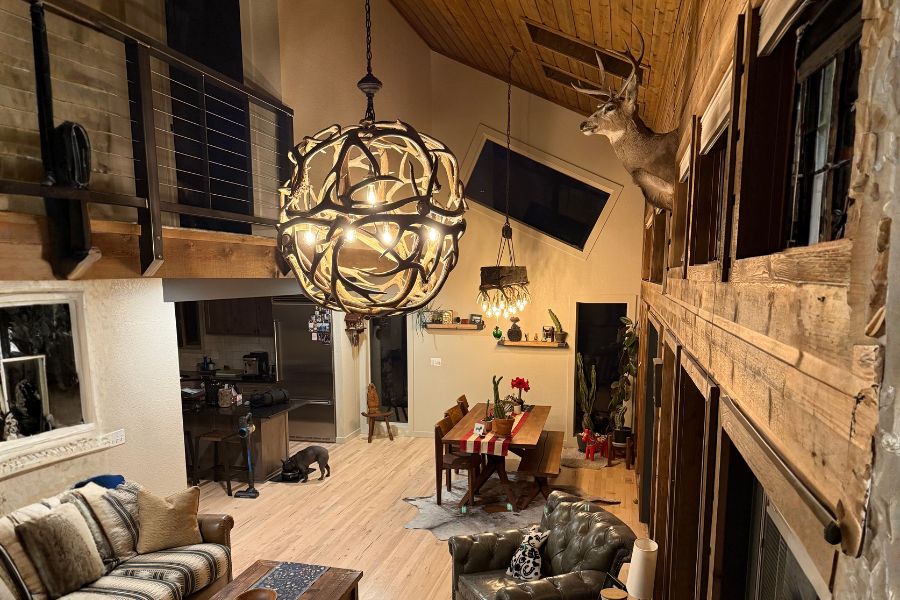
How a Custom Antler Chandelier Is Built
Construction begins with antler selection. Each piece is pulled from graded inventory and dry-fit against the others, each antler being evaluated for sweep, taper, tine count, and how it sits against its neighbors. For a large chandelier, this means working through hundreds of antlers to find the ones that belong in the piece. The antlers are arranged, adjusted, rearranged, and locked into position once the silhouette and proportion hold.
From there, the work shifts to electrical. Channels are drilled through the interior of the antlers to route the wiring harness. Junction points are sealed and color-matched to the natural surface. When the chandelier is finished, no wiring is visible, so the fixture reads as antler and light, nothing else. All lighting is constructed using UL-approved components, tested for polarity, and subjected to a 1000-volt overload test.
The full build, from selection, fitting, drilling, wiring, finishing, to testing, takes approximately eight weeks. Each stage is documented and shared with the client as the work progresses.
Sizing a Custom Antler Chandelier to Your Space
Scale is the single most consequential decision in a chandelier commission. A piece that is too small disappears into a vaulted ceiling. A piece that is too large overwhelms the room. Getting it right requires measuring the space carefully and understanding how ceiling height, room dimensions, and furniture placement interact.
Ceiling Height and Fixture Clearance
For chandeliers hung over a dining table or bar, the bottom of the fixture should sit 32 to 36 inches above the surface. This keeps sight lines clear while placing light where it is needed. The following chart shows the rough guidelines for choosing the proper size.
| Ceiling Height | Lighting Size, Dining | Lighting Size, Bar |
| 8 feet | 32 inches tall | 22 inches tall |
|
9 feet |
44 inches tall | 34 inches tall |
| 10 feet | 56 inches tall | 46 inches tall |
The goal is not to “crowd” the ceiling and not have a fixture hang too low in the room. An extra chain can always be added to position the fixture proportionally in the space.
For chandeliers used as overhead fixtures (in bedrooms, living rooms, entries, or hallways) the bottom of the fixture needs to clear head height. The available space for the fixture depends on the ceiling:
| Ceiling Height | Max. Lighting Height |
| 8 feet | 18 inches |
| 9 feet | 28 inches |
| 10 feet | 40 inches |
| 12 feet | 64 inches |
| 14 feet | 88 inches |
| 18 feet | 136 inches |
| 24 feet | 208 inches |
These dimensions define the vertical envelope. The chandelier does not need to fill the entire available height, but knowing the maximum prevents specifying a piece that will hang too low for the room.
Room-by-Room Sizing Considerations
Over a dining table, the chandelier should be narrower than the table itself. The piece should ideally be wide enough to light the surface and narrow enough that no one bumps it sitting down. For a standard 42-inch round table, that means roughly 36 inches at most.
Ceiling height opens up more options. With 10 feet or more overhead, a two-tier design fills the vertical space without spreading wider than the table below. For long tables, a pair of smaller chandeliers or a linear design like the Snowmass oval chandelier covers the length more evenly than a single round fixture. As a rule of thumb, the fixture should leave 12 to 24 inches of table exposed on each end. A 10-foot table works best with a 6- to 7-foot fixture, and a 42-inch-wide table works best with a fixture in the 32- to 36-inch range.
Entries and foyers work differently. A low-ceiling entry needs a compact fixture that clears head height and still reads from the front door. A tall foyer with a staircase is the opposite problem; too small a fixture and the space swallows it. Tiered chandeliers work here because lights at two or three levels fill the height rather than leaving the upper half of the room dark.
Great rooms with ceilings of 14 feet or higher are where stock fixtures fall short. Most off-the-shelf chandeliers are not built for that volume and hang in the space without filling it. A commissioned piece is sized to the room during consultation, with ceiling height, furniture layout, and sight lines all factored in. In one 24-foot-square, double-height great room, we used a matched pair of 24-light Mt. Elbert chandeliers centered over two seating areas to light the space from floor to ceiling.
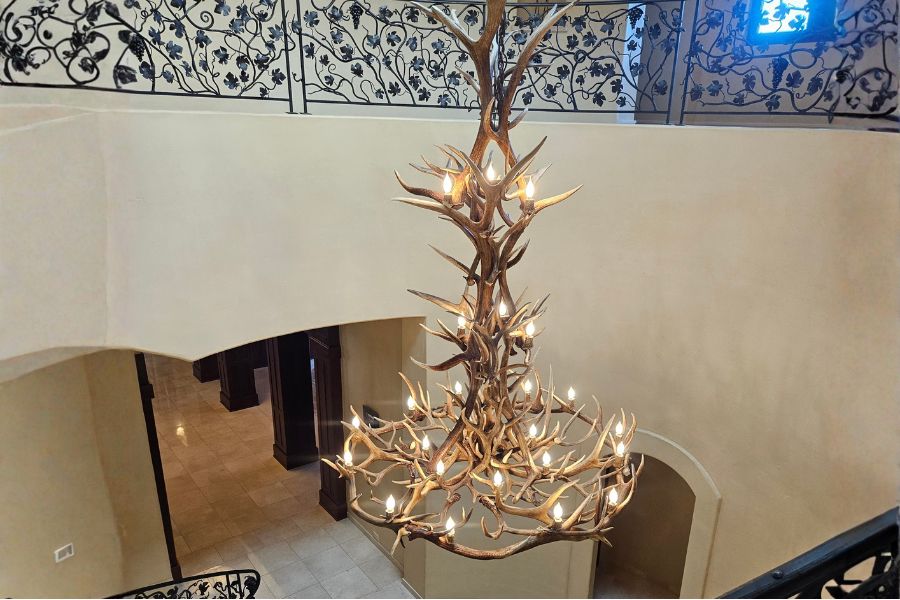
Delivery Clearance
One factor that is easy to overlook: the finished piece needs to fit through the door. Door width, hallway turns, and stairwell clearances are discussed during consultation. For large commissions, the chandelier may be designed in sections that are assembled on site.
Planning Light Output for Your Room
A chandelier that looks right but leaves the room dim has only done half the job. How much light a fixture needs to deliver is just as important as how it looks.
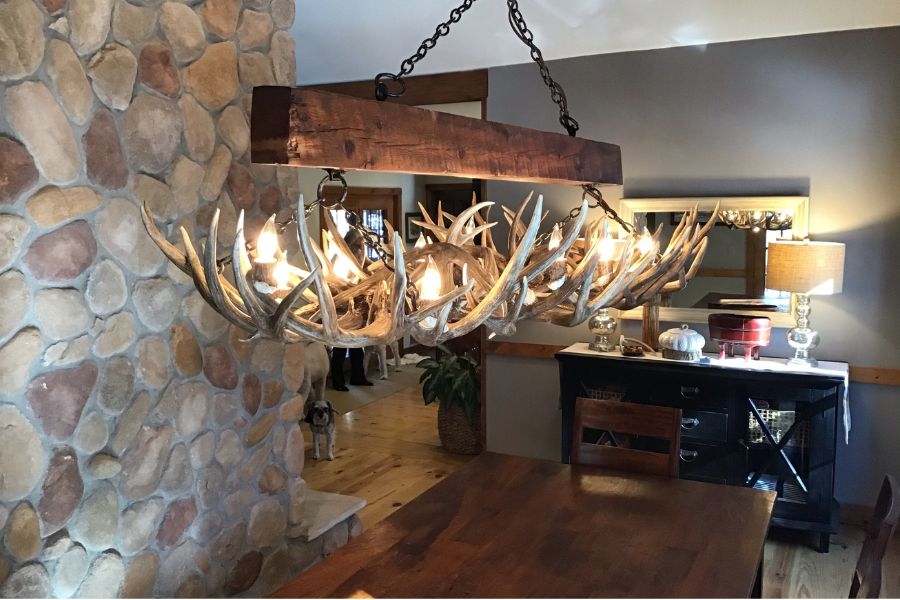
Ambient, Task, and Layered Lighting
Different rooms need light for different reasons. A great room needs enough ambient light to fill the space evenly for everyday use. A dining table needs brighter, directed light for the surface where people are eating and talking. A kitchen island needs enough to work by. Most rooms work best with layered lighting, with the chandelier handling the primary load, and sconces, pendants, or lamps fill in around it.
A dimmer makes almost any chandelier more versatile. Full output for cooking or cleaning, dialed back for dinner or the end of the evening.
Calculating Lumens
Lumens measure how much light a bulb actually emits, and modern bulbs vary more than most people expect. A flame-tip LED produces around 400 lumens on just 4.5 watts. A vintage Edison bulb, the kind with the visible filament, delivers only 220 lumens at 60 watts. Two chandeliers with the same number of sockets can light a room very differently depending on what is in them.
The math for figuring out how much light a room needs is straightforward. Measure the area, then multiply by the lumens-per-square-foot target for how the space is used:
|
Lighting Purpose |
Lumens per Square Foot |
|---|---|
|
Ambient lighting |
20 lm/sq ft |
|
Dining table surface |
30 lm/sq ft |
|
Task lighting |
50 lm/sq ft |
Example — dining table: A 96 × 42-inch table is about 28 square feet. At 30 lumens per square foot, the surface needs roughly 840 lumens to light properly — but the math only tells part of the story. Four lights on an 8-foot table may technically cover the lumens, but it is not practical. The fixture will look sparse, and the light will not distribute evenly across the surface. An 8-foot table should receive a 5- to 6-foot fixture with 8 to 10 uplights and a couple of downlights to wash the table surface. The lumens calculation is a useful guide, but the chandelier also needs enough lights spaced around it to look complete and light the space proportionally.
Example — full dining room: A 14 × 16-foot dining room is 224 square feet. At 30 lumens per square foot, the whole room needs around 6,720 lumens. Peak Antler supplies 3.8-watt LED bulbs with every fixture, each producing 300 lumens. At that output, a single chandelier would need roughly 22 lights to cover the room on its own. In most cases, the chandelier is not the only light source — wall sconces, buffet lamps, or recessed lighting share the load, which means a smaller fixture can handle the primary role while supplemental sources fill in around it.
Example — great room: A 24 × 24-foot great room at 20 lumens per square foot needs approximately 11,520 lumens of ambient light. At 300 lumens per bulb, that comes to roughly 38 bulbs if the chandelier is the only source in the room. It rarely is. Most great rooms have canned lights, lamps, and other fixtures working alongside the chandelier. A pair of chandeliers or a single large multi-tier fixture running 16 to 36 lights is typical, with the rest of the room’s lighting carrying the balance.
These numbers frame the conversation. During design consultation, bulb type, socket configuration (candelabra, downlight, or both), and dimmer compatibility are all specified alongside the physical design so the chandelier lights the room the way it needs to, not just the way it happens to.
The Commission Process
A custom antler chandelier begins with a conversation about the space. Ceiling height, room dimensions, furniture layout, design direction, and antler preferences are discussed during the initial consultation. From there, the process follows a defined sequence:
The design is developed to a specific scale and configuration. Species, tier count, light count, and finish are determined. For clients who need to visualize the piece in their room, we composite the chandelier design into photographs of the actual space.
Production begins with a 50% deposit. The build takes approximately eight weeks, with progress documented and shared throughout. Final payment is due prior to shipment. Each piece ships with installation guidance and, for designer and architect commissions, full documentation, fixture weight, UL-electrical components, and testing specifications.
For interior designers and architects working on commercial or residential projects, trade pricing is available through our wholesale program.
Frequently Asked Questions
What is the difference between real and faux antler chandeliers? Real antler is naturally shed bone. It is dense and variable in shape because no two antlers grow the same. That variability is what allows a custom chandelier to be composed rather than assembled. Faux antler is cast from polyresin or ceramic molds, producing uniform shapes that lack the asymmetry, surface grain, and structural density of the real material. A faux fixture may approximate the look from across the room, but it does not carry the same weight, texture, or aging character.
How do I know what size antler chandelier I need? Start with the room. Ceiling height determines the maximum fixture height. Room dimensions and furniture layout determine the appropriate width and light count. The sizing charts in this guide provide the starting framework. During consultation, we refine those dimensions to the specific space; accounting for sight lines, delivery clearance, and how the piece will read from different positions in the room.
How long does it take to build a custom antler chandelier? The build requires approximately eight weeks from deposit. That timeline covers design, sculptural composition, internal wiring, finishing, and testing. Larger or more complex commissions may require additional time. Progress is documented and shared throughout the build.
Can a custom chandelier be designed for a room with standard 8- or 9-foot ceilings? Yes. The available fixture height is 18 to 28 inches in that range, and species selection and configuration are adjusted accordingly.
What a Custom Antler Chandelier Does in a Room
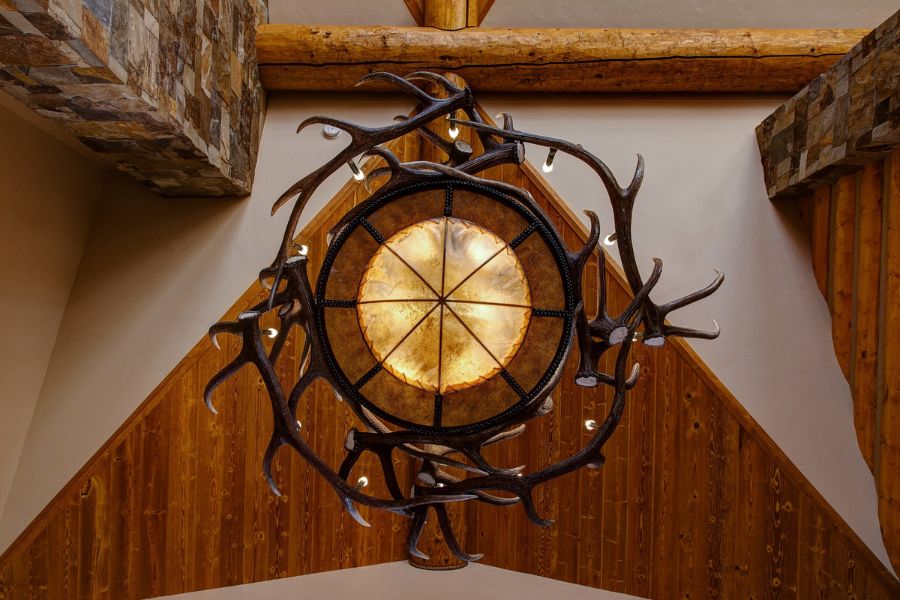
A custom antler chandelier is the first thing a person sees when they walk into the room. By day, it holds the space as the antlers are set against timber, stone, or open ceiling. At dusk, it becomes the light the room is built around. A piece commissioned and built for a specific room will outlast the renovation, the furniture beneath it, and most of the fixtures in the house.
To see what is possible at different scales, browse the current chandelier collection. To understand the full build process, read about the benefits of commissioning a custom antler chandelier.